
What does God really want people to do for him?
Should we build him a great temple? Should we solve the world’s problems? Maybe we should produce great works of art in his name. Or we might grow into the very best version of ourselves. We surely should win the world for him by making disciples.
The answer is, “Yes!” and “No.”
Solomon built him a great temple. Mother Teresa did much to alleviate the pain of others in the world. Davinci and Michelangelo produced timeless works for God’s glory. George Washington Carver though born a slave completed his college degree and gained the skills to serve God through scientific discovery. Eric Liddell won the gold medal in the 400-meter race at the 1924 Olympic games. The apostle Paul preached the gospel throughout the known world in his lifetime.
These are all wonderful examples of service for God and I’m sure he was pleased with them all.
But Jesus didn’t do any of those things. Yeah, he preached the gospel, but to know observable effect. From an honest, earthly assessment nobody would say that Jesus was a success. He amassed some followers, but they all abandoned him when he needed them. Ultimately, he died a criminal’s death having written nothing, built nothing, achieved nothing. With the exception of a few people he healed, nobody was better off for Jesus having been here. Is that what God wanted?
Yes!
“Get behind me, Satan.”
Jesus knew what he would suffer in Jerusalem, yet he went. In the town of Caesarea Phillipi Jesus asked his disciples who people thought he was:
They replied, “Some say John the Baptist; others say Elijah; and still others, Jeremiah or one of the prophets.”
“But what about you?” he asked. “Who do you say I am?”
Simon Peter answered, “You are the Messiah, the Son of the living God.”
Jesus replied, “Blessed are you, Simon son of Jonah, for this was not revealed to you by flesh and blood, but by my Father in heaven. And I tell you that you are Peter, and on this rock I will build my church, and the gates of Hades will not overcome it. I will give you the keys of the kingdom of heaven; whatever you bind on earth will be bound in heaven, and whatever you loose on earth will be loosed in heaven.” Then he ordered his disciples not to tell anyone that he was the Messiah.
Matthew 16:14-20 NIV
Can you imagine the electricity that surged through those disciples as Peter confidently affirmed what they’d all been wondering? He said it and it couldn’t be unsaid. In all the speculating, none would dare to identify him as Messiah (“Christ” in Greek). The implications were just too great. And too dangerous. But now Peter has confessed it and with that confession has become a foundation stone in the brand-new society Jesus would build. Talk about great expectations!
But this moment of high optimism wouldn’t last long. In the very next verse, we’re told:
From that time on Jesus began to explain to his disciples that he must go to Jerusalem and suffer many things at the hands of the elders, the chief priests and the teachers of the law, and that he must be killed and on the third day be raised to life.
Matthew 16:21 NIV
Jesus was the Christ. That was Lesson 1. Now that they had learned it, they were ready for Lesson 2 – Christ must be crucified.
Lesson 1 hadn’t come easy. God the Father had to reveal it to Peter.
Lesson 2 would be even harder.
Look at Peter’s response:
Peter took him aside and began to rebuke him. “Never, Lord!” he said. “This shall never happen to you!”
Matthew 16:22 NIV
I’m not sure if we fully appreciate Peter’s perspective from this side of the cross. We think of the pain that Christ suffered in his passion, but we can’t appreciate the loss Peter found unimaginable. With all of his virtue, wisdom, and power, Jesus overflowed with glorious potential. Surely all that couldn’t be thrown away – wasted for nothing! Peter knew the world needed Jesus. How could he be taken away?
I sympathize with Peter, but Jesus didn’t. It would be hard to imagine a more devastating rebuke than the one our Lord hurled at his closest disciple:
Jesus turned and said to Peter, “Get behind me, Satan! You are a stumbling block to me; you do not have in mind the concerns of God, but merely human concerns.”
Matthew 16:23 NIV
Jesus called Peter, “Satan.” It’s a word that means, “Adversary.” Peter spoke as a friend, but Jesus heard the voice of The Enemy. Maybe you’ve heard that voice as well? Here’s what it sounds like:
“You can do better than that?”
“Don’t be a loser.”
“What do you have to show for what you’ve been doing?”
“How are you going to get yourself out of this one?”
“What are you accomplishing?”
These all seems like reasonable considerations. In fact, we might wonder if anyone will get anything done at all without evaluating the outcome of their efforts. And yet, within them are demonic seeds. Outcome-based thinking makes sense to the people of this world. That means it’s worldly wisdom. But the world is polluted by demonic influence. Which is why Jesus’ brother James wrote:
Who is wise and understanding among you? Let them show it by their good life, by deeds done in the humility that comes from wisdom. But if you harbor bitter envy and selfish ambition in your hearts, do not boast about it or deny the truth. Such “wisdom” does not come down from heaven but is earthly, unspiritual, demonic. For where you have envy and selfish ambition, there you find disorder and every evil practice.
James 3:13-16 NIV
We want things to go well for ourselves and the people we care about. We look around and witness incompetence and evil. Then we start to think we need to fix things. We think we need to straighten other people out. We aspire to have some sort of influence for the sake of the common good. All along the way we follow the best of intentions until we find ourselves the enemies of God and the destroyers of everything good.
The Pharisees in Jerusalem weren’t bad people. They wanted to worship God and encourage other people to do the same. But sometimes if you’re going to make an omelet, you have a break a few eggs. That was their thinking after Jesus raised Lazarus from the dead:
Then the chief priests and the Pharisees called a meeting of the Sanhedrin.
“What are we accomplishing?” they asked. “Here is this man performing many signs. If we let him go on like this, everyone will believe in him, and then the Romans will come and take away both our temple and our nation.”
Then one of them, named Caiaphas, who was high priest that year, spoke up, “You know nothing at all! You do not realize that it is better for you that one man die for the people than that the whole nation perish.”
John 11:47-50 NIV
On the one hand we have Jesus making the irresponsible choice to be executed rather than use his power and influence for the good of the people. On the other hand, we have leaders seeking to preserve the holy city and system of worship. Who are the good guys?
When we seek to control the outcomes even for the good, we aspire to Godhood and thereby join Satan in his ancient program.
Does that mean we shouldn’t aspire to anything or seek to do good? Not at all.
Faithfulness. Not success.
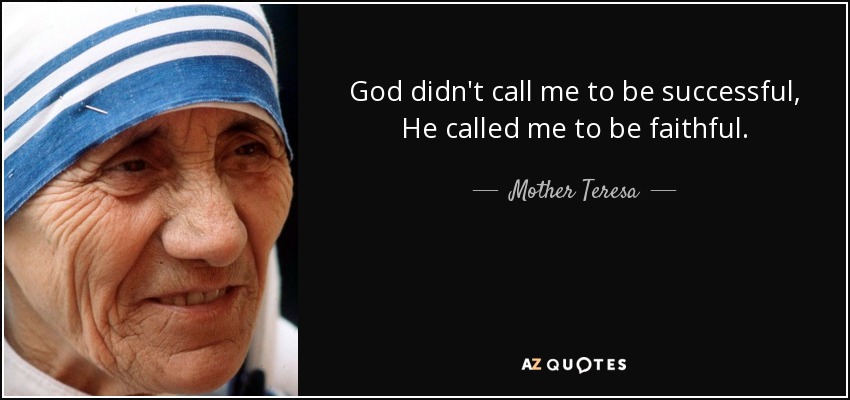
We all want our lives to count for something. We want a result from our being here. I think that’s what we see in the lives of the people I mentioned and it’s what the Jewish leaders who crucified Jesus wanted. God wants us to produce as well, but we can’t produce godly results on our own. That’s why it’s called, fruit.
In John 15, Jesus said that he is the vine, and we are the branches. God, the vinedresser wants us to bear fruit for him. But we can’t bear fruit by trying to bear fruit. That comes from the vine and the vinedresser. We can only get in the way.
If we set out to bear fruit, we’ll quickly discover that we don’t have the means. So, we’ll resort to Satan’s method – deceit. We’ll deceive ourselves into thinking we’re more capable than we are. We’ll deceive others into thinking we’ve done more than we have.
We can only legitimately bear fruit as we remain in Christ. We do that by trusting obedience – faithfulness. As we simply obey him over the long haul, we’ll find that our lives are producing results. Where we find we lack resources to obey, we can pray and find even greater results. These aren’t the accomplishments that the world looks for, but the kind of lasting fruit God wants.
Bottom line, if we seek to be faithful, we will produce fruit for God. If we seek to be successful, we will produce fruit for Satan.
Here are some practical differences between seeking to be successful and seeking to be faithful.
- If we seek to be successful, we’ll regularly face despair and denial over our shortcomings and missteps. If we seek to be faithful, we’ll never fail even if we fall short of our potential or do something foolish. We can admit our faults, learn from them, and keep going.
- The pursuit of success attempts to overcome a mountain of challenges at once. Living in faithfulness is done step by step – one right thing after another.
- Seeking success paralyzes us in a never-ending loop of second guessing. We can be faithful by getting going and making corrections along the way.
- The pursuit of success arises from the perception of lack and so requires that we provide all resources to achieve it. Faithfulness overflows from gratefulness and has an inexhaustible source.
It takes faith to be faithful. If we’re responsible for outcomes, we must seek success at all costs. If we can trust God with the outcomes, we can simply do the next right thing in the moment – praying for anything we yet need.
God has you at school and in wrestling. Neither your academic nor your athletic performance are your domain. Give those to God. It’s your job to be faithful. That means using your time well at any given moment and giving your best effort to everything you do.
Don’t seek good grades; learn.
Don’t try to be the best; train the hardest.
You aren’t a scholar or an athlete; you’re a disciple of Christ being trained to be like him as a college wrestler. If you were anywhere else doing anything else, your job description would be the same.
And whatever you do, whether in word or deed, do it all in the name of the Lord Jesus, giving thanks to God the Father through him.
Colossians 3:17 NIV

 Wrestle With God